As an employer on a self-sponsored healthcare plan, you’re probably already feeling the pressure of the rising premiums and lack of transparency in plans.
You can keep healthcare costs in check with reference-based pricing healthcare (RBP). With this strategy, you can standardize expenses for the same healthcare services across different providers. Instead of paying inflated prices, you pay a fair, transparent rate based on a trusted benchmark.
The result? You get predictable costs, better control over your healthcare spending, and a plan that finally makes sense for both your business and your employees.
Let’s dive into how reference-based pricing works and why you should be considering making the switch.
What is Reference-Based Pricing in Healthcare?
Reference-based pricing is a cost containment strategy for employers with self-insured medical plans. It’s set up to protect you from inflated provider charges for specific healthcare services.
Here’s how the RBP plans work:
- The insurance provider sets a maximum price based on a benchmark, such as Medicare reimbursement or actual hospital costs.
- Third-party administrators (TPAs) decide the right healthcare costs by reviewing and auditing medical bills, then adding a fair profit margin.
- A well-implemented RBP pricing structure can help minimize your annual healthcare costs.
- With RBP pricing, healthcare costs are no longer linked to a provider’s arbitrary or inflated charges, like with traditional network contracts.
Reference-Based Pricing vs Traditional Insurance Plans
Traditional insurance plans, like preferred provider organizations (PPOs), set healthcare prices based on negotiated network-specific discounts from inflated provider charges.
Let’s take a closer look at reference-based pricing vs. traditional insurance plans by comparing their main features with the table below:
| Feature | Reference-Based Pricing | Traditional Insurance Plans |
|---|---|---|
| Provider Payment | Pays providers based on a transparent benchmark | Pays providers according to pre-negotiated network contracts |
| Price Transparency | Complete visibility on claim costs | Hidden costs in the network contracts |
| Cost Control | Up to 30% premium cost savings | Constant premium increases |
| Provider Network | Employees can visit any provider that accepts RBP payments | Stuck with in-network providers |
| Administration | Managed by a Third-Party Administrator (TPA) | Handled by insurance carriers |
| Patient Costs | Lower overall costs due to reduced claim spend | Higher premiums and cost-sharing |
Benefits of Reference-Based Pricing for Employers and Employees
The shift by many self-funding employers to RBP is gaining momentum fast, and this can be attributed to the following benefits:
For Employers
Employers who switch to RBP often report experiencing these benefits:
- Reduce Plan Costs: Setting monthly premiums based on Medicare reimbursement rates can result in significant cost reduction compared to traditional PPO plans.
- Meet Your Fiduciary Duties: Since RBP follows a transparent method, you can meet your ERISA fiduciary duties by managing costs and making objective decisions.
Learn more about the ERISA compliance checklist. - Increase Price Transparency: You can see exactly how each claim is priced because it’s tied to a preset benchmark.
- Long-term Sustainability: RBP pricing is a sustainable alternative to annual premium hikes, allowing you to budget accurately and efficiently.
- Greater Plan Control: Gain control over plan design and payment structures rather than relying on opaque insurer contracts.
For Employees
RBP isn’t just about cutting costs; it is also about your employees getting more tailored healthcare options.
Here’s how they benefit:
- Freedom to Choose: RBP plans allow employees to visit any provider willing to accept the plan’s payment terms, rather than being confined to a specific network of providers.
- Lower Premiums: When premiums are low, it means your team can have smaller contributions.
- Education and Support: RBP plans often educate their employees about their healthcare decisions and help them understand the costs of various services.
To achieve this, you have a fiduciary duty to ensure your RBP plan is negotiated transparently and it’s in your organization’s best interests.
Ethos Benefits is a fiduciary benefits consultant company, and we use data-driven insights to help you design an RBP plan that works for your business, budget, and employees.
Contact us today to learn how we can help you build your RBP strategy and reduce your healthcare expenses.
Key Components of Reference-Based Pricing Models
A successful RBP model is built on transparency, structure, and strong administrative support.
While every RBP plan can look slightly different, here are the core elements in most of them:
- Benchmark: It serves as the reference point for determining how RBP provider payments are calculated. It’s typically 140 – 200% of Medicare costs and ensures all payments are transparent and consistent.
- Payment Cap: There should be a maximum amount that an RBP plan will reimburse for specific services and procedures. This cap serves as an incentive for providers to offer competitive rates, enabling employees to make cost-effective choices.
- Patient Education: You need to help your employees understand how RBP works so that they can utilize their benefits efficiently and effectively. You can achieve this by training on how to choose the right providers and providing them with step-by-step instructions in case of balance billing.
- Third Party Administrator (TPA): A TPA manages your reference-based pricing plan, and their roles typically include reviewing charges and repricing them, negotiating your member advocacy, and balancing your bill negotiations.
- Ongoing Data Analytics: You must continuously track data to refine benchmarks and strengthen your RBP plan over time. You can monitor your RBP pricing plan performance and identify ways to contain costs.

How Reference-Based Pricing Works
Your reference-based pricing plans will be managed by a third-party administrator, who typically takes the following approach to ensure you enjoy fair healthcare pricing:
1. Set a Reimbursement Rate
You, the employer, in consultation with your third-party administrator (TPA) and benefits consultant, determine the percentage above Medicare that your plan will cover for eligible services.
This percentage typically ranges from 120% to 200% of Medicare costs, depending on the type of service and the local market.
Example:
- Medicare pays $1,000 for a specific outpatient surgery.
- Your RBP plan sets the reference rate at 160% of the Medicare rate.
Formula:
Benchmark rate x percentage=Reimbursement rate
$1,000 x 160%=$1,600
Therefore, the plan will cover $1,600 for that procedure. This remains the case regardless of whether the provider’s billed charge is higher. This benchmark ensures consistent and predictable pricing across all claims.
2. Reprice Healthcare Claims
When a provider submits a bill, the TPA or RBP administrator reviews it and reprices the claim using the plan’s benchmark formula.
This step ensures that every payment aligns with the reference-based rate, rather than inflated billed charges or hidden network contracts.
3. Employees Seek Care
Since RBP plans are not limited to a traditional network, employees can visit any provider of their choosing that accepts RBP. This flexibility is especially beneficial in areas where certain specialists or hospitals are out-of-network under conventional plans.
If they’re unsure, they can reach out to the RBP administrator for price estimates and provider education.
4. Provider Submits Claims
Providers submit their claims directly to your plan administrator after an employee has received satisfactory care and treatment.
The claim is then repriced, and the provider is sent a detailed report of how the payment amount was calculated based on the plan’s benchmark.
If the provider accepts the payment, the claim is settled. If not, they issue a balance bill for the difference. A benefits consultant — not just the TPA — can step in to negotiate and resolve the bill, protecting the employee from surprise medical costs.

Implementation Strategies for Reference-Based Pricing Plans
Even when the RBP meets your needs perfectly, you need the right planning and partner to implement successfully.
You want to work with a professional benefits advisor to help you design RPB strategies. Working with Ethos Benefits will help you determine the proper benchmark.
Here is a range of services we provide to help you implement RBP plans:
- Fiduciary Advice: We employ an ERISA-compliant, fiduciary, data-driven approach to identify areas where you’re currently overpaying and to help you establish reference-based prices.
- Clear Communication Plan: We partner with RBP administrators to explain to your employees how RBP works, how payments are determined, and what employees should do if they receive a bill with a balance.
- Seamless Plan Administration: If you’re switching from a PPO plan to an RBP pricing plan, you can expect a smooth transition. We provide benefits administration technology that makes the overall process easier, from enrolling employees to auditing the plans.
- Network Management: Ethos Benefits collaborates with insurers, networks, and PBMs to help employers evaluate and negotiate plan structures
Key Questions to Consider Before Adopting Reference-Based Pricing
When switching from a traditional PPO model to a reference-based pricing model, take the time to evaluate whether you are truly ready for the transition.
Here are some questions you can ask:
- Do we have the right benefits professional who specializes in reference-based pricing?
- Are our employees ready for a change in how care is paid for?
- How will we educate employees and providers about our RBP plan?
- How will we support employees who receive a bill for the balance?
Common Challenges With Reference-Based Pricing
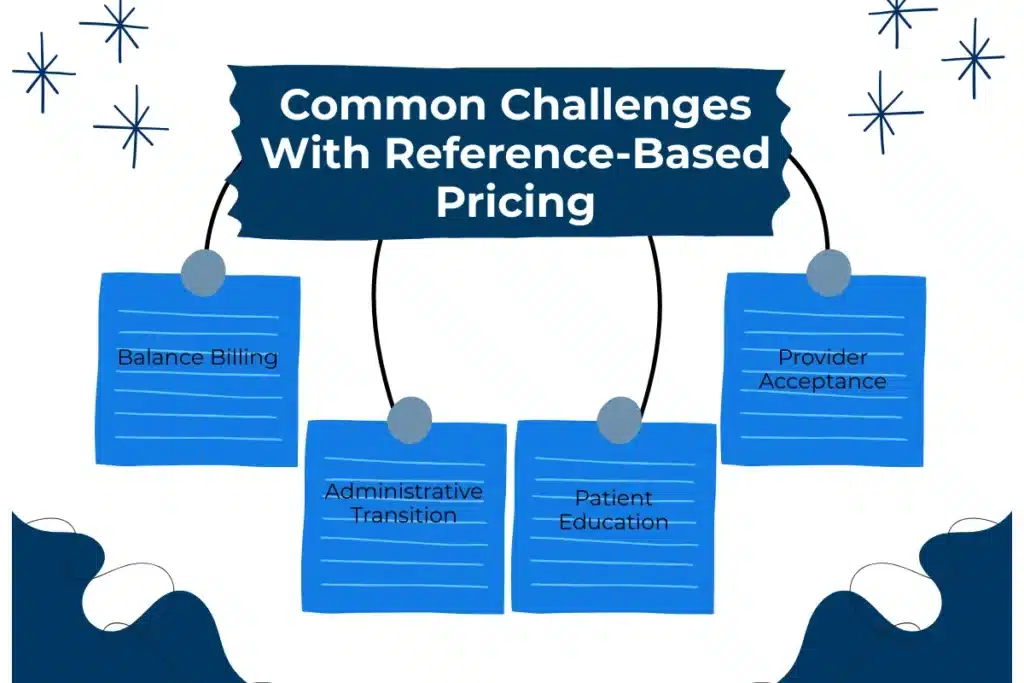
While RBP offers significant cost savings and price transparency, it also introduces a few challenges.
Here are some of the challenges you can expect when exploring RBP pricing:
- Balance Billing: This occurs when a provider charges an employee the difference between their healthcare costs and the amount covered by the RBP plan. Balance billing can occur and must be actively managed with strong member advocacy and pre-service support.
- Administrative Transition: The transition to RBP can be complex, especially after being accustomed to carrier-managed plans. However, the correct TPA will simplify claims handling, communication, and employee support.
- Patient Education: Employees who are the plan’s beneficiaries need to understand the ‘why’ behind RBP and how it works. You can make this possible by conducting pre-launch education sessions and providing easy access to member support and advocacy hotlines.
- Provider Acceptance: Because RBP doesn’t rely on traditional networks, some providers may initially be unfamiliar or hesitant to accept benchmark-based payments.
With the help of a benefits consultant, however, you can easily manage these issues.
Ethos Benefits specializes in simplifying RBP administration so your employees stay protected and your plan runs smoothly.
Frequently Asked Questions (FAQs)
Get answers to some of the most commonly asked questions about RBPs below:
What Are the Risks of Implementing Reference-Based Pricing Too Quickly?
RBP changes how claims are paid, how providers are reimbursed, and how employees use their benefits. So if you implement your RBP plan too quickly, you may encounter these risks:
- Your employees can resist and face low satisfaction.
Your team may receive balance bills and be unwilling to accept them. - Your HR team may not be prepared for the increased workload.
- You may miss out on complying with ERISA fiduciary standards.
What Happens If a Provider Rejects Reference-Based Pricing?
If a provider rejects RBP pricing, they will issue balance billings to your employees who seek their services. Many providers will negotiate or accept RBP after advocacy, but a portion will not, and that must be planned for.
Sometimes, they may initially question or reject RBP, but with proper education, most providers get behind it.
Does Reference-Based Pricing Work With Self-Funded Plans?
Yes.
RBP pricing works with self-funded health insurance plans. It provides self-funded employers with the tools to take control of rising healthcare costs while maintaining fairness and flexibility in provider payments.
Conclusion
Switching to reference-based pricing puts employers back in control of their healthcare budgets. Instead of paying arbitrary network rates, you pay fair, benchmark-based prices that reflect real value.
Ready to explore RBP for your organization?
Ethos Benefits helps employers like you design and manage reference-based pricing plans that deliver transparency, savings, and lasting value.
With our fiduciary expertise, we can handle everything for you, from setting up a benchmark rate to educating employees, so you can focus on running your business. We operate on a flat-fee model, ensuring our compensation remains stable regardless of your plan costs.
Schedule a discovery call, and let’s design a transparent RBP plan with our fiduciary expertise.