

A family-owned HVAC company with 500 employees in Central Florida bet on themselves — and proved that lower cost and better care aren't mutually exclusive.


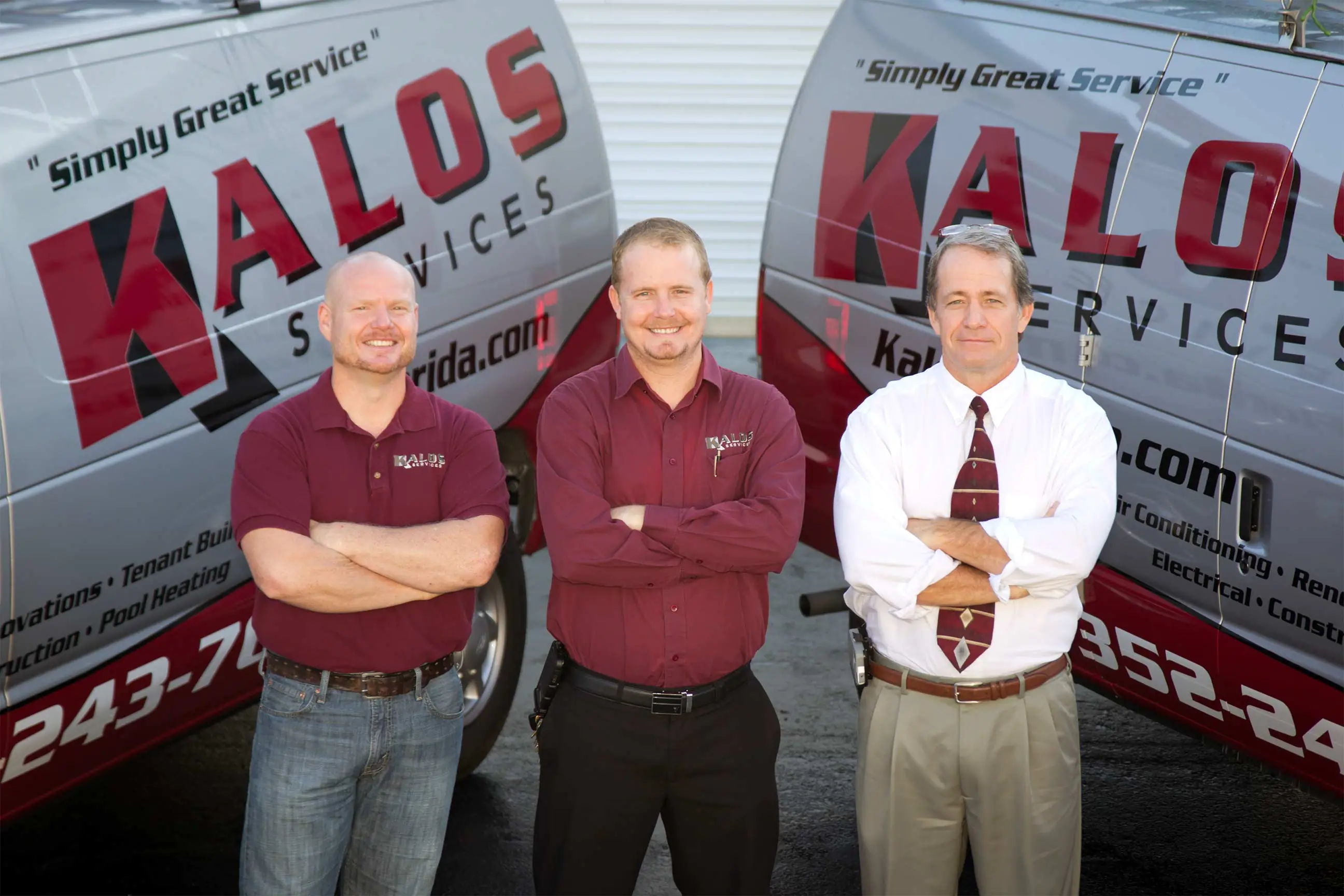

Kalos Services is a full-service residential and commercial contractor headquartered in Clermont, Florida. Founded by Bryan Orr and his family, Kalos handles HVAC, electrical, plumbing, refrigeration, and general contracting — all in-house, all under one roof. Named a Top Workplace by USA Today and the Orlando Sentinel, Bryan is also the creator of HVAC School, the largest free HVAC training platform in the world.
Bryan didn't just let us put together a case study — he went on stage at a major employer conference and brought Donovan on his podcast in front of 100,000+ listeners. No script, no filter, no gatekeeping.
Bryan, Chelsea, and Donovan on stage in front of 100+ employers. The numbers, the stories, the Q&A — unscripted. 12 clips from this talk are paired throughout the case study with their podcast counterparts.
Bryan brings Donovan on his podcast with 100K+ listeners to break down every aspect of the plan: PBM, reference-based pricing, DPC, and real claims stories.
"It hasn't been easy, but it's been worth it. This is primarily not about money. It is about money, but it's not primarily about money. And what we save, we return to our employees. We actually wrote everybody a check out of the plan."
When Bryan told his previous brokerage that he was leaving, they didn't respond with data. They didn't offer a counter-strategy. They didn't demonstrate how they'd earned the account.
They begged. And then they threatened. Here's how Bryan described it on stage at the Florida Healthcare Alliance conference:
"We were still talking to the prior broker and they were begging us. And it wasn't just like, 'Oh please, we make so much money off you, please stay.' It was like — you guys are making a horrible mistake. You're going to regret this. I mean, it was really extreme."
"And these are people who I've known for a long time. Very nice people. They were always trying to take me to lunch and always trying to take me to basketball suites. I wonder how they had all that money anyway. They're always wanting to take me places for some reason or give me things."
— Bryan Orr, Florida Healthcare Alliance Conference, May 2025
Bryan and his HR director Jamie sat down and weighed the decision. It was a real moment:
"There was a real panic around that. I remember Jamie and I sitting down saying, do we do this? This is unknown territory for us. But the numbers speak for themselves, and the level of transparency that Ethos was able to bring to the table was so much greater than what they could provide. They could beg me and threaten me all day long, but they wouldn't show me anything that helped me make a different decision. And that became fairly apparent."
What the old broker never mentioned — not once — was the $16.7 million in claims flowing through a plan they were supposed to be managing. They never talked about the 81% discount Kalos would eventually achieve by simply questioning the bills they had been rubber-stamping for years. They never brought up the PBM spread pricing silently extracting hundreds of thousands a year. They never suggested direct primary care, reference-based pricing, or audit rights. The only strategy they had was fear. The only pitch was trust us — and when that didn't work, you'll regret this.
The result since leaving:
These aren't hypotheticals. These are real claims from real Kalos employees — and the difference between what the system tried to charge and what they actually paid.
A Kalos employee was having a delivery at a hospital the plan had paid hundreds of times before. The pre-authorization came back at $37,594 — compared to a $13,000 Medicare rate and the $18,865 national average reported by KFF.
The Kalos plan settled at $18,000 — right at the national average and well below what the hospital initially demanded. The employee got the care they needed, at the facility they chose, without being asked to change their birth plan. That's a $19,594 savings on a single claim — Since January 2025, four Kalos employees have had their deliveries covered completely free. When you have multiple deliveries a year across a 500-person company with a lot of young families, these numbers compound fast.
A Kalos employee was bitten by a spider on his pinky finger and needed a skin graft. Nothing complex. The local hospital tried to pre-authorize the service for $81,516. Even with their supposed 30% "discount," the price was still $57,061.
Instead of accepting it, the team asked one simple question: "Where else does this surgeon have privileges?" Same physician, redirected to an ambulatory surgical center a few miles away. Total paid: $2,098. Plan savings of nearly $55,000. And the employee saved $4,500 in out-of-pocket costs they would have hit at the hospital.
"No HVAC business could operate the way hospitals operate. It's not overbilling by 10% or 40%. These hospitals really try to bill back the health insurance in multiples." — Donovan Ryckis
In just the last six months, 21 advanced imaging services were routed through direct contracts with imaging centers. The results: $3,300 in direct employee savings and $9,157 in employer savings — on imaging alone. And the appointments were easier to book and faster to complete than hospital-based imaging.
The pricing gap is staggering. An MRI at a hospital can run $16,000. The same scan at a direct-contracted imaging center comes in under $500. With a traditional plan, nobody tells the employee this. They go where they're referred and the cost flows through to premiums. With the Kalos plan, a care coach guides employees to quality, fairly-priced providers before they walk in the door.
208 total members enrolled in the direct primary care option — and 71% engaged with their DPC provider within the first six months. Instead of waiting 17-21 days for an appointment and getting 7 minutes with a doctor, employees get same-day or next-day access with 30 to 60 minutes of face time.
Bryan's own family used it before they were even fully enrolled. His wife called the DPC doctor about sores in their son's mouth — sent a picture, got guidance immediately, and had a plan within minutes. No phone tree, no receptionist, no 3-week wait. It's personal, it's fast, and every visit is at zero cost to the employee.
ER visits decreased by 34% inline with benchmarks since implementing DPC. Every ER visit that gets redirected to a DPC provider saves the plan $3,000+ minimum — and gives the employee a better, faster, more personal experience. That's the compounding effect: better care and lower cost, without asking anyone to sacrifice anything.
Most employers respond to rising healthcare costs by shifting burden to employees: higher deductibles, smaller networks, more copays. Kalos did the opposite. By attacking the cost structure of the plan itself — PBM spread, hospital overbilling, lack of data — they were able to lower deductibles, eliminate copays, add direct primary care, and still come in 40% below national benchmarks.
And when the plan came in under budget? They wrote every employee a check. And four employees who had babies since January 2025 received their deliveries completely free. When one IT employee left for a new opportunity in Savannah, he told Bryan the thing he'd miss most was the healthcare program: "I was able to get so many things worked out with my health. The culture around wellness has been so great."
Employers in this country have been fed a lie for the past 10 to 20 years, and the lie is simple: you can't do anything to control the cost of healthcare. They've been led to believe there's nothing to be done. Year after year, the broker comes in and says "you had a really terrible year" — as if healthcare costs are random, uncontrollable, and inevitable.
The phrase Donovan kept hearing from every employer he talked to was "the claims are the claims." It had become a mantra — a way to rationalize double-digit annual increases without asking any questions. But it doesn't actually make sense. What employers meant was "the conditions are the conditions" — you can't change the fact that someone had a heart attack or needed surgery. But a claim is a request for dollars for a covered incident. And that dollar amount is wildly variable depending on where care happens and who's negotiating the price.
At Kalos, Bryan Orr understood this distinction immediately. The conditions his employees face aren't going away — these are tradespeople doing physical work in the Florida heat. But the prices they were paying for care? Those were negotiable. The problem was that under their old plan, nobody was negotiating.
The first mindset shift was understanding that employer-based health insurance isn't really insurance at all — it's healthcare financing. Traditional insurance protects against unlikely or untimely events: your house burns down, you get in a car accident. Employer health coverage is different. Somebody at Kalos uses it every single day. They're going to the pharmacy, taking their kids to the doctor, getting imaging done. It's a certainty, not a contingency.
Once you understand it's healthcare financing, the idea of a "hope and wish strategy" — just hoping next year's claims will be better — becomes obviously absurd. Your rates are going to be based on your group's own claims experience. Which means you need all the data. You need to know where every penny goes.
When Kalos came to Ethos, they were restricted on data. Their prior carrier treated claims information as proprietary. That was the first thing to fix — not the premiums, not the network, not the plan design. You have to unlock the data before anything else can work.
The pharmacy benefit manager is always the first thing Ethos addresses, and for good reason: it's the most nefarious piece of any healthcare plan, the easiest to fix, and it causes zero disruption to employees.
In Kalos's case, the insurance company owned its own PBM — a textbook case of self-dealing. The PBM sets the prices on drugs for Kalos, takes a spread in between, and the company never has a conversation about it. Nobody ever asks "what should my drugs cost?" Because the PBM is marking up prices internally and the employer never sees the real numbers.
For a company Kalos's size, fixing this typically means hundreds of thousands of dollars in annual drug spend reduction. Employees can go to all the same pharmacies. Nobody changes their medication. Nobody fills out new paperwork. The only thing that changes is that an insurance company's hidden profit disappears.
Key Principle: Any successful benefit strategy should not be based on asking employees to do something for the employer. It should be the employer saying: this is what we're going to do to help the employees.
When you choose a big-name insurance company, what you're really choosing is a network — pre-negotiated rates for any service that could be performed. The problem is that the carrier will never tell you what those rates are. They treat it as proprietary. You'll never know what your network is paying per procedure, per facility, per service. It's impossible to benchmark.
The Kalos plan works differently. Using Medicare reimbursement as a reference point, the plan negotiates every high-dollar claim individually. The results since October 2022: $16.7 million billed, $3.2 million paid — an 81% discount across the entire claims portfolio. And that's not cherry-picking. That's every claim, over two and a half years, through a network replacement strategy that treats each bill as a negotiation, not a fait accompli.
The key insight: you don't need to renegotiate every claim. About 3-5% of people will generate the claims in the six figures. That's where the negotiation happens, and that's where the savings compound. The vast majority of employees experience zero friction — everything is processed automatically.
When employees do engage in the process — like the employee who made two phone calls about the cash price for her delivery — they share in the savings. It's not punitive. The system rewards participation rather than punishing it.
There are two systems working hand-in-hand in any healthcare plan: healthcare finance (where the money goes) and healthcare delivery (where the care happens). Both are confusing. Ethos addresses both.
On the delivery side, Kalos employees have access to a care coach — someone who helps them navigate the system before they make decisions that could cost them and the plan significantly more than necessary. Where should I go for imaging? Who should I see for a specialist? Can I get a second opinion?
The plan also includes access to specialty centers. Instead of defaulting to the big-box hospital for every procedure, employees can be guided to facilities like the Mayo Clinic in Jacksonville or Florida Cancer Specialists — organizations that specialize in specific conditions, deliver better outcomes, and know how to bill fairly because they do the same thing every day.
Direct primary care was added as an elective option in the plan's first year. The concept is simple: same-day or next-day access to a primary care physician, with 30 to 60 minutes of face time per visit, at zero cost. Employees can get stitches, blood work, generic drugs, and guidance on specialists — all without the 17-to-21-day wait that forces people into ERs and urgent cares unnecessarily.
Bryan put it best on the podcast: "Can you imagine if we did that? Hey, we charged Mrs. Jones $6,000 for a change-out, and then Mrs. Thompson $45,000. And we don't give any reason. It's just because we decided that's what we're gonna do."
Every HVAC contractor in the country understands fair pricing, transparent quoting, and honest billing. They can't operate the way hospitals operate. And yet, when it comes to their own company's healthcare plan, they've been told to just accept whatever the system charges.
Kalos stopped accepting that. They applied the same principles of transparency, fair pricing, and accountability to their healthcare plan that they apply to every job they do. And the results — 40% below national benchmarks with better benefits, lower deductibles, and direct primary care — prove that the system isn't broken because it has to be. It's broken because nobody's pushing back.
Bryan's closing thought: "Being aware of what's going on in healthcare and what your options are is going to empower you, going to empower your employees. Healthcare is a battle right now. It is not easy, but the results are good outcomes for our employees."
Bryan co-founded Kalos at 23 and built it into a 220+ employee, multi-trade operation in Central Florida. He's also the creator of HVAC School — the largest free HVAC training platform in the world — host of the HVAC School Podcast, and father of 10. Author of "Unconformed."
Connect on LinkedInFormer Series 65 RIA who transitioned to healthcare benefits consulting after uncovering the transparency gap. Donovan leads Ethos as the nation's first fiduciary-first benefits consultancy — fee-only, zero vendor conflicts, and accountable to the client only.
Connect on LinkedInEvery client engagement follows the same fiduciary-grade methodology — adapted to the specific cost drivers and governance needs of each organization.
We start by auditing the existing plan — not by quoting carriers. We analyze claims data, contract terms, compensation structures, and identify where the actual cost drivers are hiding. For Kalos, this meant first unlocking the data that their prior carrier had restricted.
We separate the plan into independently marketable components: network, TPA, PBM, and stop-loss. The PBM carve-out alone delivered hundreds of thousands in savings for Kalos with zero employee disruption.
We prioritize changes that deliver the highest ROI with the least employee disruption. For Kalos, that meant PBM optimization first, then reference-based pricing on high-dollar claims, then adding direct primary care as an elective option.
Every high-dollar claim gets reviewed, negotiated, and settled at fair rates. Care coaches guide employees to the right providers at the right price. Specialty networks connect Kalos employees to facilities like Mayo Clinic and Florida Cancer Specialists at no additional cost.
In Bryan's own words on the HVAC School podcast — what the Ethos engagement changed about how Kalos thinks about healthcare.
"We're betting on ourselves. We're focused on a plan where we're really footing the bill for the care that's being provided. But in that, we're also negotiating a lot better and getting better healthcare outcomes."
"I know where every single penny in our healthcare plan goes. That was the first step — freeing that up. Making sure we're capturing to the penny." The era of "trust us" billing is over.
"We are not taking away from employees. We're also not delaying care in any way." Lower costs came from fixing the system, not from higher deductibles or smaller networks.
Zero copays on mental health, imaging, and mail-order Rx. Direct primary care with same-day access. And when savings were achieved, the company wrote every employee a check from the plan surplus.
This isn't a tech startup. It's a family-owned HVAC, electrical, plumbing, and construction company. If Kalos can do this with 500 employees in the trades — saving $13.5M in claims and cutting Rx costs by 70% — any employer can.
"We are not the easiest client. It has been a battle to make this happen. Healthcare is a battle right now. It is not easy, but the results are good outcomes for our employees." — Bryan Orr
"Employers have been fed the lie that you can't do anything to control the cost of healthcare. The truth is, you can't change the fact that somebody had a heart attack. But you can absolutely change how much you paid for it. That's the disconnect — and it's costing American businesses billions."
Download the full Kalos Services case study as a formatted PDF — including the detailed claims analysis and benchmark comparisons. Perfect for sharing with your benefits committee or leadership team.
Every engagement starts with a no-obligation diagnostic of your current plan. No carrier quotes. No sales pitch. Just data.

They were locked out of their own data
When Kalos came to us, they were on a traditional fully-insured carrier plan with restricted data access. The biggest challenge wasn't the premium — it was that nobody could see where the money was going. We couldn't benchmark, we couldn't analyze, and we couldn't strategize. The prior carrier treated their claims data as proprietary information.
Step one wasn't fixing the plan. Step one was getting transparency. You can't manage what you can't measure. With 500 employees averaging 18 claims per insured person per year, that's roughly 10,000 claims annually — likely one of the largest areas of accounts payable for any company this size. And in a trades company doing physical work in the Florida heat every day, this isn't hypothetical utilization. These are real claims, real families, real needs.
The pharmacy benefit manager was silently extracting — we cut Rx costs by 70%
The PBM is always the first place we look, and it's always the first thing we fix. In Kalos's case, the insurance company owned their own PBM, which was internally setting drug prices — a textbook case of self-dealing. After implementing a fiduciary PBM with manufacturer assistance programs and international sourcing where appropriate, Kalos's Rx cost dropped to $17 per member per month — a 70% decrease.
One example: an employee on Taltz for psoriatic arthritis was paying $7,100 bi-weekly. After clinical review confirmed it was medically necessary (the fifth drug tried), we sourced it through international mail order at $3,500 bi-weekly. Employer savings: $93,600 annually. Member savings: $2,080 — and $0 out of pocket for the international sourcing. Same medication, same outcomes. Zero disruption.
Hospitals billing 12x to 16x Medicare rates — and nobody was pushing back
Once we had data access, the picture became clear very quickly. We were seeing hospital bills come through at 12 times, 16 times what Medicare pays for the same procedure. A procedure that should cost $8,000 to $12,000 would come in at $120,000 to $180,000. And under the old plan, nobody was questioning any of it.
We settle medical claims between 110% and 300% of Medicare — which sounds like overpaying, but in the context of medical insurance, that's remarkably less than what carriers were paying without question. You only need to catch two or three of these a year to change the entire financial picture of a plan. And it's only affecting the top 3-5% of claims. The vast majority of employees never experience any friction at all.
He understood immediately: this is healthcare financing, not insurance
Most employers have been trained for 20 years to believe "the claims are the claims" — that healthcare costs are random, uncontrollable, and the best you can do is switch carriers every few years. Bryan got past that instantly. He understood the distinction between conditions (which you can't change) and claims (which are wildly variable based on where and how care is priced). And he understood the scale: with 500 employees generating 9,000 claims a year, healthcare is likely one of Kalos's largest line items after payroll.
But more importantly, Bryan was willing to fight for it. He left a Top 10 brokerage firm that told him he was making a mistake — and the numbers have since proven exactly the opposite. His family has been personally involved in testing the plan. There have been battles with providers. But the results speak for themselves: $13.5 million in claims savings, a 70% reduction in pharmacy costs, and a company that returned surplus directly to employees. That's what happens when an employer takes ownership of the problem.
Bottom line: Kalos is the case study I point to when someone says "this only works for white-collar companies." This is a 500-person trades company in Florida with 9,000 claims a year — and they're benchmarking 42% below national averages, have saved $13.5 million in claims costs, cut Rx spend by 70%, and reduced ER visits by 34%. Not by cutting benefits. By understanding the system, demanding transparency, and refusing to accept that the claims are the claims.